

Ad Serving & Brand-Protection Suite
An in-house ad serving stack, plus a monitoring system built as an alternative to Adment and BrandVerity — detecting affiliates bidding on brand terms and ads running outside policy.
Client
EdTech (India/US)
Service
Platform Engineering
Date
January 1, 2022
Challenge
Affiliates paid on performance have an incentive to bid on the brand's own name, which means the brand pays a commission for traffic it would have got for free. Commercial monitoring tools exist, price accordingly, and still have coverage gaps in the geographies and query sets that matter most.
Solution
Sampling search results from multiple geographies on the queries worth protecting, capturing ad copy and landing pages as evidence, running violations through a rule engine, and driving an alerting and takedown workflow from the result.
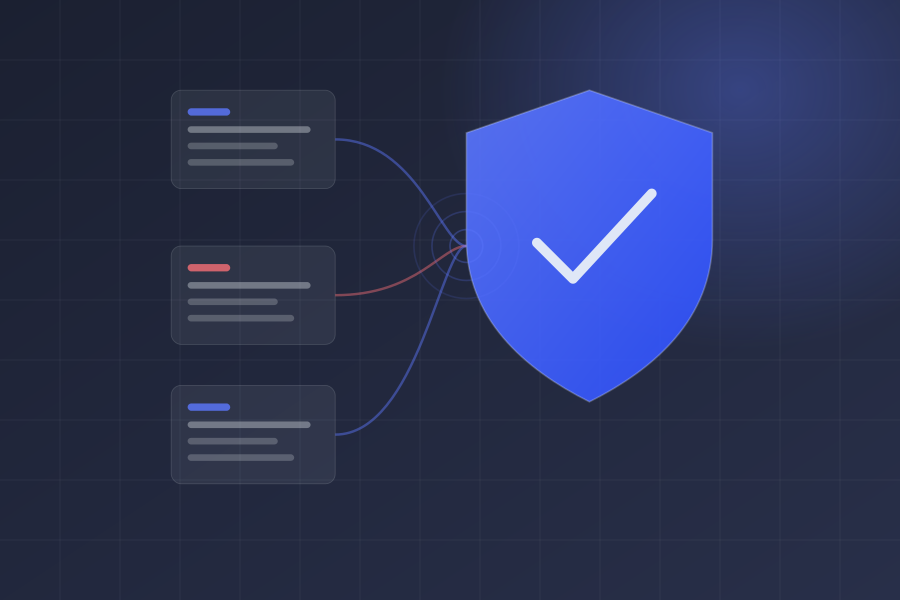
Two halves of the same problem
Serving. An in-house ad stack: slot inventory, targeting, pacing so a campaign’s budget spends across its window rather than in the first hour, and click and conversion tracking that reconciles with what advertisers were billed.
Policing. The reason the second system exists is that performance-based affiliate marketing contains a built-in arbitrage. An affiliate earns a commission for delivering a converting visitor. The cheapest converting visitor available is someone already searching for the brand by name. So the affiliate bids on the brand term, intercepts traffic the brand would have received organically, and invoices for it. From inside the ad account this looks like an affiliate performing extremely well.
Commercial brand-protection tools address exactly this. They are also expensive, and their coverage is a function of which locations and which queries they sample — which is where the gaps were.
What was built
Distributed sampling. Search results collected from multiple geographies, because a violating ad is often geo-targeted and simply invisible from anywhere else. The query set covers brand terms, common misspellings and brand-plus-modifier combinations, which is where most of the abuse actually lives.
Evidence capture. A violation claim needs proof. Every detection stores the ad copy, the display and destination URLs, the redirect chain that identifies which affiliate it was, a screenshot, and a timestamp. Redirect-chain resolution is the part that does the real work: the visible URL is rarely the affiliate, and without unwinding the hops you know an ad violated policy but not who to bill for it.
A rule engine. Not every brand-term appearance is a violation — some partners are contractually permitted, some appearances are legitimate editorial. Rules encode who may bid on what, in which geography, with what landing page. Findings are graded rather than uniformly alerted, so the team’s attention goes to real abuse instead of to noise.
Workflow. Detection feeds alerting and a takedown process with the evidence already attached, so enforcement is a decision rather than an investigation.
The economics were the justification: the system cost less to build and run than the licensed alternative, and it recovered its cost in commissions that were no longer being paid out for traffic the brand already owned.