

In-House Enterprise CRM & Lead Management
A custom CRM and Lead Management System built to replace licensed Zoho and LeadSquared deployments, together with the in-house ads system that fed leads into it.
Client
EdTech (India)
Service
Platform Engineering
Date
August 1, 2023
Challenge
Licensed CRMs price per seat and model a generic sales pipeline. A counselling funnel is not a sales pipeline, so every workflow change became a vendor configuration exercise, and the cost scaled with headcount rather than with value delivered.
Solution
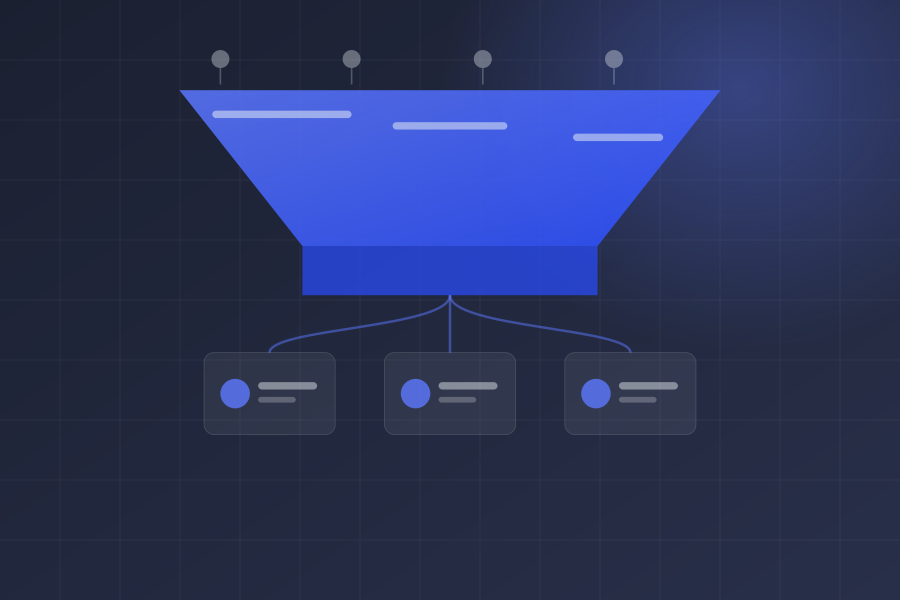
Build it. Lead ingestion and de-duplication, rule-based routing to the right counsellor, a workspace built around the counselling conversation rather than around a deal record, and reporting that answered the questions the business actually asked.
The buy-versus-build call
Two licensed products were in use: one for CRM, one for lead management. Both worked. Both had the same two structural problems.
The first was pricing. Per-seat licensing means the tool gets more expensive precisely as the organisation succeeds, and the cost has nothing to do with how much of the product is being used. At the scale this operated, the annual licence was a meaningful line item.
The second mattered more. A vendor CRM models a deal: a value, a stage, a close date. A counselling funnel is a conversation — a student with preferences, a shortlist that changes as they learn more, an application cycle with hard external deadlines. Fitting that into a deal record meant every team invented its own convention in the notes field, and any real workflow change went into a queue behind whatever the vendor was prioritising.
What was built
Lead ingestion and de-duplication. Leads arrive from ads, organic forms, calls and partners, and the same student frequently arrives twice. De-duplication ran on ingest so two counsellors never worked the same person independently.
Routing. Rules-based assignment on the attributes that actually predict conversion — course interest, geography, language, counsellor load and skill — rather than round-robin. Speed matters here: routing latency is dead time during the window when a lead is still warm.
A counsellor workspace. Built around the next action rather than around the record. Everything needed for the next conversation on one screen, with telephony integrated so call outcomes were logged as a side effect of working rather than as data entry.
Reporting. Funnel-shaped rather than pipeline-shaped, so the business could see where leads stalled by source, counsellor and stage, and act on it in the same day.
The ads system. The other half of the loop: inventory, placement and lead capture on the acquisition side, feeding the same ingestion path so paid and organic leads were handled identically.
Replacing a working vendor tool is only correct when the domain genuinely does not fit the vendor’s model. This one did not, and owning it meant a workflow change was a deploy rather than a support ticket.